
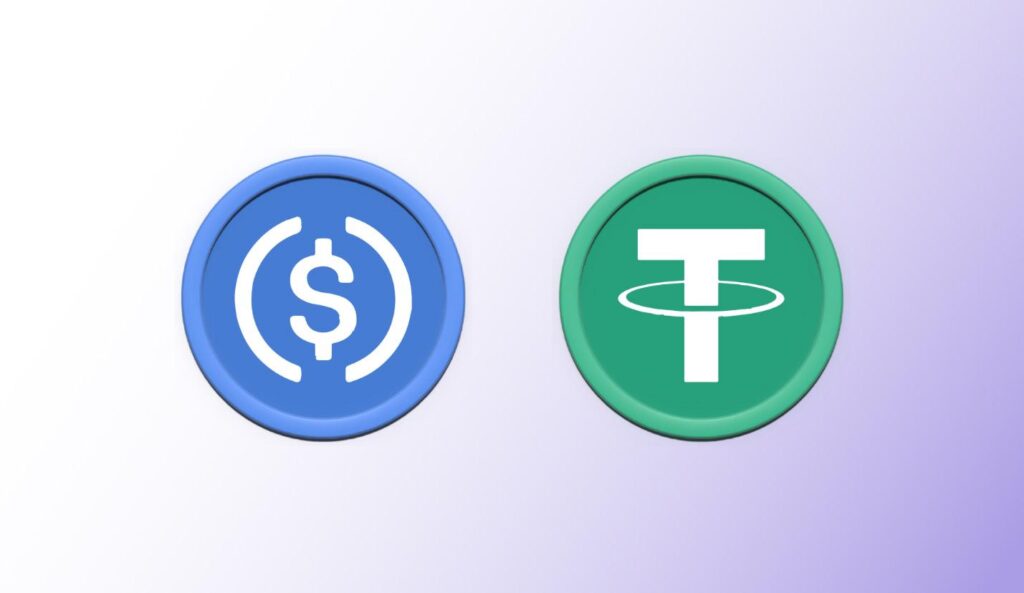
Bitcoin has proven that cryptocurrency can move value without relying on traditional banking rails. But using a volatile asset as a payment unit creates a separate problem: the value of the payment can change while the transaction is being used.
That distinction becomes particularly important when cryptocurrency is being used to fund a gaming balance.
Imagine depositing $1,000 worth of Bitcoin. If the BTC price rises or falls while the balance is being used, the number of BTC may remain unchanged, but its U.S. dollar value can move significantly. The player is therefore dealing with two variables at once: the outcome of the gaming activity and the market price of the asset.
Stablecoins approach the problem differently.
USDT and USDC are designed around a value relationship with the U.S. dollar, making them more suitable for users who want their payment unit to remain relatively predictable. That does not make stablecoins risk-free. Instead, it changes the type of risk involved.
This is why stablecoin payments are becoming an important part of the broader discussion around digital settlement, including online gaming.
The distinction is simple:
|
Asset Type |
Primary Characteristic |
Payment Consideration |
|
Bitcoin |
Market value fluctuates |
Payment value can change with BTC price |
|
USDT |
Designed around the U.S. dollar |
Greater short-term value predictability |
|
USDC |
Designed around the U.S. dollar |
Greater short-term value predictability |
The more interesting question is not whether stablecoins are “better” than Bitcoin. It is whether they are better suited to the specific job of moving and settling value.
Bitcoin Works Differently When It Becomes a Payment Unit

Holding BTC Is Different From Spending BTC
Bitcoin’s volatility is not automatically a weakness. For an investor, price movement is part of the reason to hold the asset.
A payment transaction has a different objective.
When someone pays for a product or service, predictable purchasing power is generally more useful than exposure to an asset whose market price can move substantially over a short period.
Consider the difference:
As an investment asset:
- Price appreciation can be beneficial.
- Volatility can create opportunities.
- The holder may intentionally accept market exposure.
As a payment asset:
- Predictability becomes more important.
- Price changes can alter the effective cost of a transaction.
- The recipient and sender may both care about the value at settlement.
The issue can therefore be summarized as follows:
An asset can be excellent for transferring value while still being less convenient as a predictable unit of payment.
A Simple Gaming Example
Consider a hypothetical $1,000 BTC gaming balance.
Day 1
The player deposits $1,000 worth of BTC.
During the session
BTC rises by 8%.
At withdrawal
The BTC quantity may not have changed in the same proportion as its dollar value. The player’s external purchasing power is now different because the cryptocurrency itself moved.
Reverse the scenario.
If BTC falls by 8%, the player can experience a decline in the dollar value of the remaining balance even if that change has nothing to do with the gaming result.
The player is effectively exposed to:
Game outcome + cryptocurrency price movement
That second variable is what makes volatile cryptocurrencies different from stablecoin-based settlement.
The 370 Million-Transaction Study Offers A Different View Of Stablecoins
One of the most useful ways to understand stablecoin infrastructure is to look beyond market capitalization and examine how transactions actually behave.
An August 10, 2026 study by Kundan Mukhia and co-authors examined approximately 370 million USDT and USDC transactions on Ethereum, using six observation periods between June 2024 and February 2026.
That scale makes the research particularly relevant when discussing stablecoin payments as infrastructure rather than simply treating stablecoins as digital versions of dollars.
Four Types Of Ethereum Interactions
The researchers separated transactions into four categories:
This distinction matters because a wallet-to-wallet transfer is economically different from a transaction involving a decentralized application, automated settlement process, or smart contract.
For example, stablecoin activity can involve:
- Direct wallet transfers
- Smart-contract interactions
- Automated settlement
- DeFi activity
- Contract-to-contract transactions
The blockchain may record all of these as transactions, but their economic purposes can be very different.
The Heavy-Tailed Finding
The study found heavy-tailed scaling behavior across USDT and USDC transactions and across the different interaction categories.
Two broad scaling regimes were identified:
|
Transaction Category |
Approximate Scaling Range |
|
EOA-Involved Transactions |
1.45–1.60 |
|
Smart Contract → Smart Contract |
1.72–1.73 |
The important takeaway is not simply that stablecoins are widely used.
It is that stablecoin activity is not one uniform payment market.
The size and behavior of transactions can change depending on what type of entity is sending, receiving, or interacting with the asset.
That becomes particularly interesting for gaming because the actual payment path can involve several stages:
Player wallet → payment processor or platform wallet → internal account → withdrawal wallet
The blockchain handles the asset transfer, while the gaming platform can maintain a separate internal accounting and settlement layer.
USDT And USDC Should Not Be Compared Using One Number
USDT and USDC are often compared through market capitalization, but that tells only part of the story.
Transaction count, transfer volume, adjusted volume, circulating supply, and liquidity can produce very different pictures.
USDT: Large-Scale Established Usage
USDT remains the dominant stablecoin by market presence, but transaction-volume data can look different depending on the methodology used.
One June 2026 report cited in the research material found that USDT represented approximately 25% of adjusted stablecoin transaction volume during H1 2026, while USDC represented roughly 70% under that particular methodology.
That should not automatically be interpreted as meaning one stablecoin is universally more popular.
USDC: Strong Transaction Momentum
Another August 2026 analysis reported a different picture. In that dataset, USDT represented 66.92% of stablecoin transaction volume in H1 2026, while USDC transaction count increased by 209.02% and transaction volume increased by 101.63%.
At first glance, those numbers appear contradictory.
They are not necessarily contradictory because different datasets can use different definitions, filters, adjustments, and measurement periods.
That leads to one of the most important lessons when analyzing stablecoin activity:
Market capitalization, transaction count and transaction volume are different measurements of the market.
For anyone evaluating stablecoin payments, knowing which metric is being measured is just as important as knowing the number itself.
What Stablecoins Change For Gaming Payments
The payment argument becomes easier to understand with a fixed-dollar example.
Scenario A: $1,000 In Bitcoin
A player deposits:
$1,000 worth of BTC
Potential variables include:
- BTC/USD price movement
- Changes in the dollar value of the bankroll
- Network transaction costs
- Platform settlement conditions
- Withdrawal value
The player is exposed to both the result of the gaming activity and the market price of BTC.
Scenario B: $1,000 In USDT
The player deposits:
$1,000 USDT
The intended value relationship is approximately:
1 USDT ≈ $1
This reduces the type of market-price exposure associated with BTC.
However, several other risks remain:
- Network fees
- Wallet mistakes
- Platform or counterparty risk
- Stablecoin issuer risk
- Potential depeg risk
Stablecoins therefore reduce one variable without eliminating the broader risks of cryptocurrency transactions.
Scenario C: $1,000 In USDC
The same basic structure applies:
$1,000 USDC → gaming balance → withdrawal
The key difference is that the user is not deliberately using an asset with Bitcoin-like market volatility as the spending unit.
|
Factor |
BTC |
USDT |
USDC |
|
Designed Around USD Value |
No |
Yes |
Yes |
|
Market Price Exposure |
High |
Lower |
Lower |
|
Network Costs |
Applicable |
Applicable |
Applicable |
|
Wallet Risk |
Yes |
Yes |
Yes |
|
Issuer Risk |
Not applicable in the same stablecoin sense |
Yes |
Yes |
|
Depeg Risk |
Not applicable in the same sense |
Possible |
Possible |
The practical advantage of stablecoin payments is therefore better described as greater payment predictability, not guaranteed safety.
The Network Can Matter More Than The Token
Choosing USDT or USDC does not tell you the complete cost or speed of a transaction.
These assets can operate across different blockchain networks, and the network selected can affect transaction economics and compatibility. Common comparisons include Ethereum/ERC-20, TRON/TRC-20 and Solana.
Think of the payment stack as five separate layers:
|
Layer |
What It Represents |
|
Asset |
USDT or USDC |
|
Network |
Ethereum, TRON, Solana, or another supported chain |
|
Wallet |
Sender and receiver compatibility |
|
Platform |
Casino or payment processor |
|
Settlement |
Deposit credit or withdrawal processing |
This creates an important rule for users:
USDT is not a complete description of a payment. The network carrying that USDT matters too.
The same principle applies to USDC.
Before making a transfer, users need to make sure the sending network and receiving network are compatible. A correct token sent through an unsupported network can still create a serious payment problem.
Transaction Size Changes The Economics
The 370-million-transaction research also highlights why stablecoin activity should not be treated as one uniform category. Transactions can vary considerably in size and interaction type.
That has a direct practical implication.
A $25 Transaction
Suppose someone sends $25.
A fixed network or processing cost can represent a relatively large percentage of the transaction.
A $2,500 Transaction
With a $2,500 transfer, the same nominal cost represents a much smaller percentage of the amount being moved.
A $25,000 Transaction
At $25,000, the focus can shift toward different concerns:
- Withdrawal limits
- Compliance checks
- Wallet security
- Counterparty exposure
- Settlement reliability
- Transaction confirmation
- Custody
This means there is no universal answer to the question of which cryptocurrency payment is “best.”
The right choice can depend on transaction size, supported network, platform rules, wallet compatibility and the user’s tolerance for different types of risk.
Where A Crypto Casino Fits Into The Payment Infrastructure
Stablecoins solve only one part of the payment equation.
A user still needs a platform that can accept the asset, credit the transaction correctly, maintain the relevant account balance and process withdrawals.
For players considering a crypto casino, the useful questions therefore go beyond whether USDT or USDC appears on a payment list.
They should also examine:
- Which blockchain networks are supported?
- Are deposits credited after the required confirmation?
- Are withdrawals subject to specific limits?
- What transaction costs can arise?
- Does the platform support the same network as the user’s wallet?
- How is the balance settled when funds move between the blockchain and the platform?
This is where the payment infrastructure becomes more important than the marketing label.
A crypto platform can support USDT, for example, while still having very different transaction conditions depending on which network is used.
Stablecoins Reduce One Risk, Not Every Risk
The strongest argument for stablecoins is predictability.
They can reduce exposure to the type of short-term market volatility associated with BTC or ETH when those assets are being used as a payment unit.
What Stablecoins Can Reduce
- BTC- or ETH-style price volatility during a transaction
- Uncertainty around the fiat value of a gaming balance
- Some friction associated with digital cross-border settlement
What Stablecoins Do Not Remove
- Network fees
- Wrong-network transfers
- Wallet security problems
- Platform or counterparty risk
- Stablecoin depegging
- Issuer and reserve risk
- Regulatory restrictions
- Jurisdiction-specific gaming issues
This distinction is essential because describing stablecoins as risk-free would oversimplify the technology.
Recent BIS commentary has also raised questions about whether stablecoins can function as a reliable large-scale payment system, including concerns around interoperability, money laundering and wider monetary-system effects.
For gaming users, the lesson is straightforward: a stablecoin can make the payment unit more predictable without making the entire transaction risk-free.
Stablecoin Payments: September 2026 Snapshot
|
Metric |
Figure |
|
USDT + USDC Ethereum transactions analyzed |
~370 million |
|
Study observation period |
June 2024–February 2026 |
|
Transaction interaction categories |
4 |
|
EOA-involved scaling range |
1.45–1.60 |
|
Smart Contract → Smart Contract scaling range |
1.72–1.73 |
|
Adjusted stablecoin volume reported for June 2026 |
$1.79 trillion |
|
Adjusted stablecoin volume reported for H1 2026 |
$8.82 trillion |
The volume figures above should be understood specifically as adjusted transaction volume under the relevant dataset’s methodology. They should not be treated as the total economic value of every stablecoin payment.
That distinction matters because blockchain transaction volume can include transfers between entities, internal movements, smart-contract interactions and other activity that does not represent a conventional consumer purchase.
What The 2026 Data Really Tells Us
Three conclusions stand out.
1. Stablecoins Are Moving Beyond A Simple Trading Narrative
The scale of stablecoin transaction activity shows why these assets are increasingly discussed as payment and settlement infrastructure rather than simply as instruments for cryptocurrency trading.
Different datasets reported trillions of dollars in adjusted transaction volume during 2026, although the exact figures depend on methodology.
That makes stablecoin payments relevant to any discussion about digital settlement.
2. USDT And USDC Behave Differently
USDT and USDC should not be treated as interchangeable simply because both target a dollar-based value.
They can differ in:
- Transaction patterns
- Liquidity
- Network availability
- Adoption
- Transfer volume
- Transaction counts
The Ethereum study reinforces this point by showing that transaction behavior also changes according to the type of wallet or smart-contract interaction involved.
3. Predictability Is The Main Gaming Advantage
The strongest argument is not that stablecoins are universally better than Bitcoin.
It is more precise:
Stablecoins can make the payment unit more predictable, allowing the player to separate the outcome of the game from the market-price movement of the asset used to fund the balance.
That is the real reason stablecoins are becoming increasingly relevant to digital gaming payments.
A Practical Checklist Before Using Stablecoins
Before transferring USDT or USDC to a gaming platform, users should check the entire payment path rather than looking only at the token name.
This approach is more useful than simply asking whether a platform “accepts crypto.” The real question is whether the asset, network, wallet, platform and settlement process all work together as expected.
More Stories
Crash Gambling Through a Crypto Trader’s Eyes: Take-Profits, Leverage and a Fixed 2% Fee
Steam’s September release wave shows simple game mechanics can still find new audiences
What steps do I need to follow to use the referral code ‘2IDaUZ’ on Toobit?