

Is Bitunix good for crypto trading? For many traders, the clear answer is yes. The platform stands out for traders who want strong futures access, a wide range of markets, and competitive fees without giving up a modern trading setup. Bitunix launched in 2021, now serves more than 4.2 million users, and supports more than 1,100 spot and futures pairs across its platform. Current market data also shows meaningful trading activity across both spot and derivatives, which gives traders a useful sense of scale when comparing Bitunix with other global exchanges.
CoinGecko currently tracks 557 coins and 563 spot pairs on Bitunix. It also tracks 569 futures pairs on Bitunix Futures, with multi-billion-dollar daily derivatives volume and open interest near $1.9 billion. That combination gives Bitunix a solid position as a futures-led exchange with visible market depth, active participation, and broad pair coverage for traders who want more than just the largest names.
A good exchange in 2026 has to deliver more than a long coin list and a mobile app. Traders want liquidity that feels reliable, fees they can understand quickly, visible reserve practices, and a platform with enough activity to support real execution. Bitunix checks those boxes well. CoinGecko’s trust score methodology looks at liquidity, scale, cybersecurity, APIs, team visibility, incident history, and proof of reserves, and Bitunix currently holds an 8 out of 10 score within that framework. That makes it a credible venue for traders who want a platform worth serious consideration.
What Bitunix Gets Right on Features
Bitunix is clearly built with traders in mind. The platform offers spot trading, futures trading, copy trading, and earn products, while its current setup includes real-time TradingView chart integration across spot and futures pairs. That means traders get access to live price and volume data, multiple chart intervals, and familiar technical tools directly inside the research process. For anyone who relies on charting and execution speed, that kind of setup is a real plus.
The strongest feature story still sits in futures. CoinGecko’s current futures statistics show Bitunix with 569 futures pairs, about $6.8 billion in 24-hour derivatives volume, and open interest of around $1.92 billion. That is the kind of activity active traders want to see, especially on a platform that focuses heavily on perpetuals. Liquidity is naturally strongest on major contracts such as BTC/USDT and ETH/USDT, which is exactly where many traders spend most of their time. If your strategy leans toward majors, perps, and fast-moving futures markets, Bitunix presents a strong and usable setup.
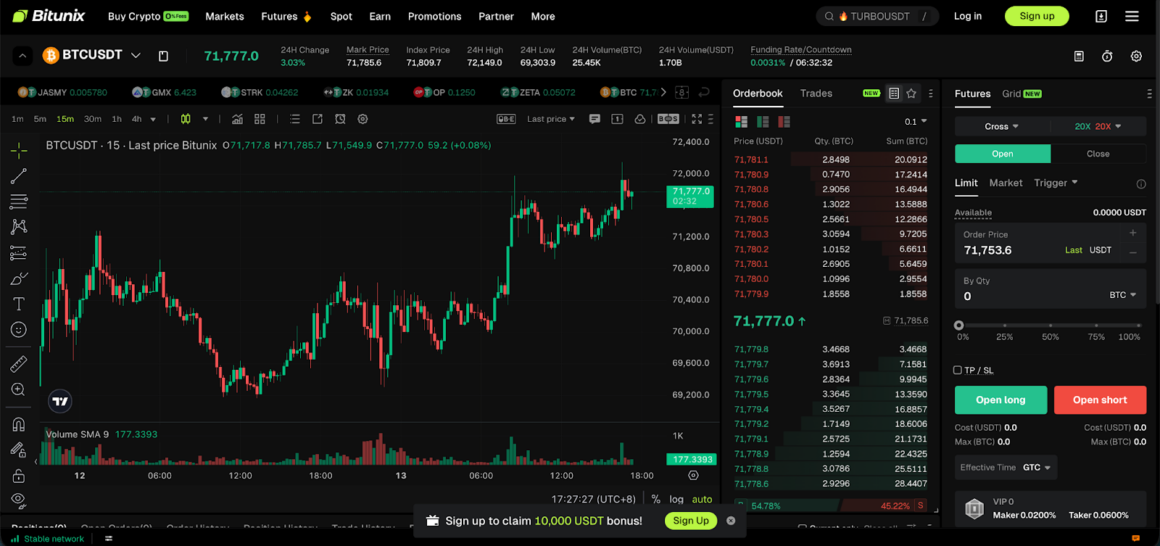
Bitunix futures interface showing the BTC/USDT market, live order book, TradingView chart, and one-click long and short execution tools.
And Bitunix has started widening that futures story beyond crypto. Its newer TradFi lineup now includes commodity-linked pairs such as XAU/USDT for gold and XAG/USDT for silver, alongside stock-linked futures such as TSLA/USDT, AAPL/USDT, NVDA/USDT, AMZN/USDT, MSTR/USDT, COIN/USDT, CRCL/USDT, HOOD/USDT, and INTC/USDT.
That gives users a way to track big macro, tech, and market-theme names from the same USDT-based interface they already use for crypto, making the platform feel more flexible for traders who move between digital assets, commodities, and equity narratives throughout the week. It is also worth noting that these are trading products tied to price movements, not direct ownership of physical commodities or company shares.
Is Bitunix Good on Fees?
Fees are one of Bitunix’s clearest strengths. Its published fee structure shows VIP 0 spot fees at 0.08% maker and 0.10% taker, while VIP 0 futures fees are 0.02% maker and 0.06% taker. The platform also scales those rates down across higher VIP tiers. At VIP 7, spot fees fall to 0.01% maker and 0.0325% taker, which creates a noticeable cost advantage for traders who are active enough to move up the ladder. For futures traders in particular, those base rates are competitive and easy to appreciate over time.
Bitunix also handles leverage in a way that fits active trading. Leverage is highlighted to be up to 200x on supported futures products, and the exact limit can vary by contract, risk tier, and market conditions. That is standard practice across derivatives exchanges and gives traders a more realistic picture of how leverage is applied in live markets. The practical takeaway is that Bitunix offers high leverage where appropriate, while traders can confirm the exact cap on the specific contract they want to trade.
Security, Reserves, and Compliance
Bitunix supports its security case with proof of reserves, a user protection fund, and external security infrastructure. User assets are backed 1:1, and the exchange supports Merkle-tree verification and publishes reserve data on external platforms such as CoinGecko and DeFiLlama. It also works with Hacken for regular security audits and vulnerability inspections. On top of that, the Bitunix Care Fund is an added layer of protection designed to respond to platform-level incidents if needed. Taken together, those measures show a platform that has put real work into transparency and user protection.
Bitunix has also continued to strengthen its custody and compliance stack. The platform has integrated Fireblocks for institutional-grade custody infrastructure and Elliptic KYT for real-time AML monitoring, while also referencing MSB registrations in the United States and Canada. That gives the exchange a stronger operational foundation and signals that it is investing in the back-end systems serious traders expect to see. As with any global platform, product availability can still vary by jurisdiction, so the smart move is simply to confirm which services apply in your region before you start trading.
Real-World Performance and Final Verdict
The overall picture is straightforward. Bitunix works well for traders who want a futures-focused exchange with broad market coverage, competitive fees, visible reserve reporting, and active day-to-day volume. The trading data supports that view, and the platform’s feature set lines up well with what active crypto traders usually care about most, especially in derivatives.
So, is Bitunix good? For many traders, yes. It is especially well-suited to people who trade major pairs, use futures regularly, pay close attention to fees, and want transparent reserve practices alongside a modern charting environment. Traders who value those things will find a lot to like here. The best next step is to check the pairs you trade most, confirm the fee tier that fits your account, and see how the platform matches your style. On balance, Bitunix makes a strong case for being a worthwhile exchange to evaluate seriously.
More Stories
Crash Gambling Through a Crypto Trader’s Eyes: Take-Profits, Leverage and a Fixed 2% Fee
Steam’s September release wave shows simple game mechanics can still find new audiences
What steps do I need to follow to use the referral code ‘2IDaUZ’ on Toobit?