
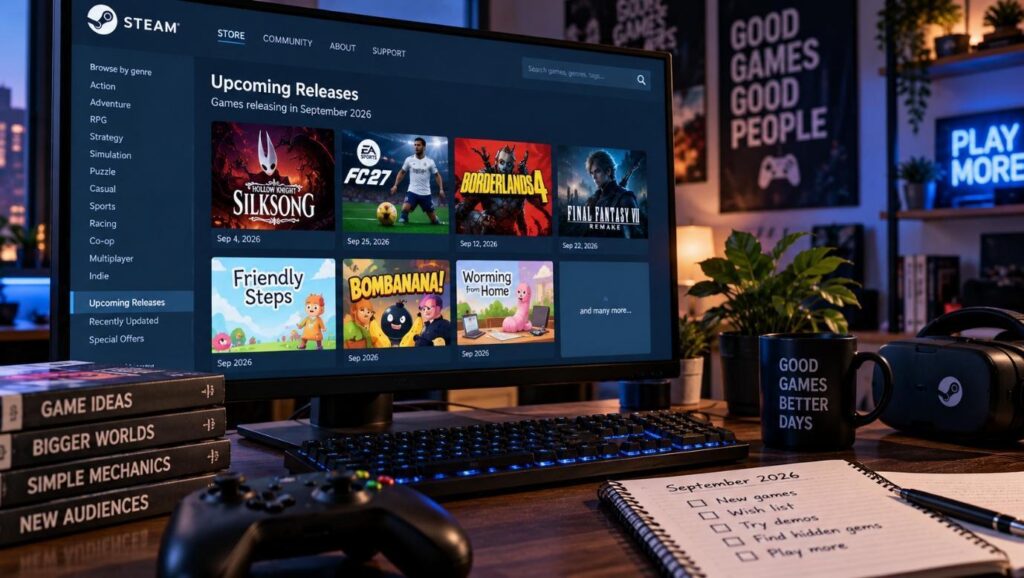
September has opened with a crowded PC release calendar. Big-budget games are competing for attention alongside co-op experiments, compact puzzle titles, physics-driven games and small simulations that can be understood within minutes. That mix matters because it shows that complexity is not the only route to visibility in a crowded market.
A crowded month leaves room for smaller ideas
Valve’s upcoming releases page lists everything from major RPGs and sports releases to titles tagged as casual, puzzle, physics and online co-op. Games such as Friendly Steps, BOMBANANA! and Worming from Home sit beside much larger launches, illustrating how Steam’s catalogue continues to give very different kinds of play a place in the same discovery system.
The same pattern is evident beyond conventional PC releases. Simple rules and immediate feedback also remain common in browser-based entertainment. A title such as the Mines game on Stake uses a compact decision loop rather than a long progression system, showing how stripped-back mechanics can coexist with much deeper forms of digital play. The comparison is about design rather than scale: not every experience needs a large world or a lengthy tutorial to communicate its core idea.
Why simple mechanics still matter
A straightforward mechanic can be valuable because it reduces the time between opening a game and understanding what the player is being asked to do. That does not automatically make a game easy or shallow. Many successful puzzle, rhythm and arcade games are built around a small number of rules that become more interesting through timing, risk, score chasing or repeated attempts.
GamesRadar’s September release overview also highlights how varied the month has become, with action RPGs, horror, strategy and other genres all arriving within the same period. That level of competition puts extra pressure on developers to make their central mechanic clear quickly, especially for smaller titles that cannot rely on an established franchise name.
That variety also changes the way players evaluate new releases. A large production can sell itself through familiar characters, a major studio or an established series, while an unknown indie game has to communicate its appeal much faster. A readable mechanic can do that work in seconds. It gives a trailer, store capsule or short social clip something concrete to show before the audience knows anything about the developer behind it.
Discovery rewards immediate clarity
The rise of demos, festivals and wish-list-driven discovery has made that clarity even more valuable. Players often encounter several games in a single browsing session and may try only a fraction of them. In that environment, the first interaction matters. A game that establishes its rules quickly can create curiosity without demanding a long onboarding sequence, while deeper systems can be introduced once the player is already engaged.
There is also a production argument for focused mechanics. Smaller teams rarely have the resources to compete with the amount of art, dialogue or cinematic content in a blockbuster. What they can compete on is the feel of an interaction, the quality of a loop and the originality of a rule set. September's crowded calendar makes that contrast especially visible, as tiny projects and major franchises arrive side by side.
Focused design still needs polish
This does not remove the importance of polish. Simple mechanics can expose weak design more quickly because there are fewer systems to hide behind. Controls, feedback, pacing and difficulty all become highly visible when the core loop is compact. The strongest small games, therefore, tend to use simplicity as a foundation rather than as an excuse, refining a narrow idea until every interaction supports it.
That range of commitment is also useful for storefronts themselves, because it allows discovery systems to serve players with very different amounts of available time rather than treating every release as a substitute for the same kind of experience.
Discovery is becoming part of game design
The September rush also underlines how important storefront presentation has become. Screenshots, short trailers, tags and the first few minutes of play often have to explain a game before a player moves on to the next listing. For independent studios, a distinctive mechanic can therefore work as both a design choice and a discovery tool.
The wider lesson is not that simple games will replace large productions. The market is broad enough for both. As release schedules become more crowded, games that communicate a clear idea quickly may have a better chance of being remembered, even when they are sharing a storefront with some of the biggest launches of the year.
More Stories
Crash Gambling Through a Crypto Trader’s Eyes: Take-Profits, Leverage and a Fixed 2% Fee
What steps do I need to follow to use the referral code ‘2IDaUZ’ on Toobit?
Europe’s Banks Are Building a Stablecoin Before Big Tech Builds One for Them