
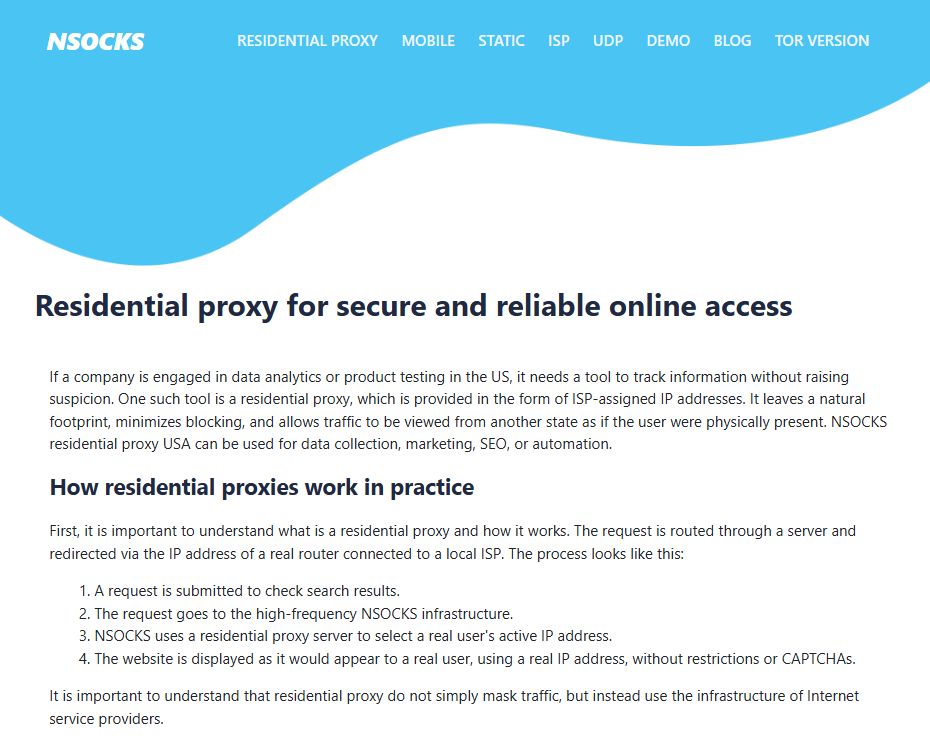
A company can build a strong storefront and still miss what real customers actually see. On the NSOCKS residential page, a residential proxy is presented as an ISP assigned route that helps content appear as it would for users in specific US locations. A local visitor may see different rankings, ads, prices, or stock signals than the internal team sees. That makes regional path testing more practical and more honest. ✨
Why local buyer path audits matter
A buyer path is made of several small decisions that happen before checkout. Search discovery, ad exposure, offer comparison, and product viewing all influence whether a person keeps moving forward. The NSOCKS page links residential access to analytics, product testing, SEO, marketing, and QA, making it suitable for checking that path from the customer side rather than from an office view.
Regional realism matters because one market view is rarely enough. Search results, campaigns, and retail conditions can vary across states. The page explains that residential access can show content as though the visitor were physically present in another state, giving teams a stronger basis for review. ✅
Before testing begins, it helps to split the buyer path into stages. Each stage should answer one commercial question instead of one broad question.
Discovery should be checked first
The residential page states that Google results vary by location. A brand can look strong from one office connection while performing differently in another state. When discovery is checked with a local route, the review starts from the same point where real users begin.
How NSOCKS supports realistic route reviews
The NSOCKS residential page presents several features that fit buyer path work. It describes ISP assigned IPs, US coverage, support for SOCKS5 HTTPS and HTTP, and multiple rotation options. Together, those elements make the service adaptable for teams that need realistic local viewing and session control.
A strong audit often needs more than one session style. Some reviews need continuity so one path can be followed from search to landing page, while others need repeated viewing across markets. The page supports on demand rotation, sticky sessions, and timed rotation, making the model flexible for both deep and broad reviews.
The page also names practical workflows including analytics, SEO, marketing, QA, price monitoring, and product testing. That keeps the setup concrete.
Sticky sessions fit complete route checks
Sticky sessions are useful when a team wants to follow one local path without changing the visible identity halfway through. A consistent route makes it easier to inspect whether the same offer, page state, and user flow hold together from start to finish. That is especially useful for funnel review and landing page QA.
Rotation fits wider market scanning
A broader audit asks a different question. Instead of tracing one path deeply, the team may want to compare several states, campaign views, or catalog conditions. In those cases, on demand or timed rotation can make the review faster and more scalable. ✅
Comparison of internal views and market facing views
Internal review is useful, but it is not market realism. Teams usually see pages through one office network, one cookie environment, and one geography. That setup can confirm that a page works while hiding how the market actually experiences it.
A market facing review asks a different question. It focuses on what a local visitor sees when the journey begins from a real target environment. The residential model on the NSOCKS page is stronger here because it uses provider based identity rather than a datacenter style route.
Market facing checks improve commercial judgment
Teams planning campaigns, price tests, or page fixes need a route that reflects the target environment more closely. The page says residential access helps reduce blocking and show content from another state as though the user were physically present there. That makes the resulting review more useful for business decisions. ✨
Types of buyer path reviews
Different commercial goals require different audit styles. Some reviews begin in search, some begin with paid traffic, and some begin inside the storefront. The residential setup on the page is broad enough to support all three, but the review type should be defined before session logic is chosen.
Search path reviews
Search reviews should focus on state specific rankings, local intent, and the first visible impression of the brand. Since the page notes that search results vary by location, this is one of the clearest uses for a local residential route. A stable session is often useful when one market is being examined closely.
Ad path reviews
Ad reviews should test whether the campaign appears as intended and whether the landing page matches the promise in the creative. The page lists marketing and ad testing among the main residential use cases, which makes this a strong fit for audience facing checks. Several markets should be compared before a campaign is treated as reliable.
Storefront path reviews
Storefront reviews are strongest when they cover pricing, stock, offer logic, and product presentation from the local user side. The page links residential access to real time data collection, price analysis, and product availability in retail chains. That makes the model useful for research teams as well as merchandising and conversion focused audits. ✅
Practical recommendations for stronger audits
A clean audit starts with one journey question. Teams should decide whether they are testing discovery, ad delivery, local offer logic, or full path continuity before opening a session. Clear scope usually produces better findings than one oversized review.
Helpful habits to keep
- ✅ Define one market question first
- ✅ Match session mode to the review style
- ✅ Record differences between states
- ✅ Start with one baseline market
Habits that weaken the result
- ❌ Mixing search ad and storefront checks
- ❌ Treating one office view as proof
- ❌ Using broad geography for a local issue
- ❌ Expanding before the first market is understood
Step by step method for a clean regional audit
Start by defining the stage of the buyer path that matters most. Then choose the state that represents the audience or market being examined, and select a session style that fits the purpose. Sticky sessions work best for full path continuity, while rotation works better for broad comparison across regions.
Next, keep the first review small. The NSOCKS page recommends starting with a small data volume and adjusting traffic routing, and that principle works well for buyer path analysis too. A limited first run reveals whether the route and the question were chosen correctly before the team expands the scope.
Finally, compare each local path against a baseline instead of judging results in isolation. A baseline makes it easier to see whether a change is truly regional or part of the normal page pattern. Strong comparison improves the value of later optimization. ✨
Pros and limits of this model
Residential buyer path simulation has a clear strength. It gives teams a more realistic view of what local users may experience across discovery, offers, and page quality. It is especially useful when the work depends on trust, geotargeting, and audience facing realism rather than only on raw speed.
Main advantages
- ✅ Better realism for search ad and storefront checks
- ✅ Strong fit for analytics marketing and QA
- ✅ Flexible session logic for broad or deep review
- ✅ Coverage across all 50 states
Main limitations
- ❌ Higher cost than basic datacenter access
- ❌ More planning is needed before the audit
- ❌ The wrong session style can weaken the route
- ❌ Simple tasks may not need it
The strongest use of the NSOCKS residential page is not generic anonymity. It is the ability to examine how regional buyer journeys actually look from the customer side. For teams seeking better commercial decisions, residential access becomes a practical tool with value for teams today.
More Stories
Tamasha Bet Live Casino Login Guide (Step-by-Step Access)
Climate-Tech Is Booming—Here’s What Founders Need to Know
The amazing Claudio Caniggia